Dash falls 8.1% in 24 hours and misses Bitcoin’s late rebound
Dash fell 8.09% in a matched Coinbase dollar window. In the final two hours, Dash fell further while Bitcoin recovered and Zcash was nearly flat.
Published
On this page
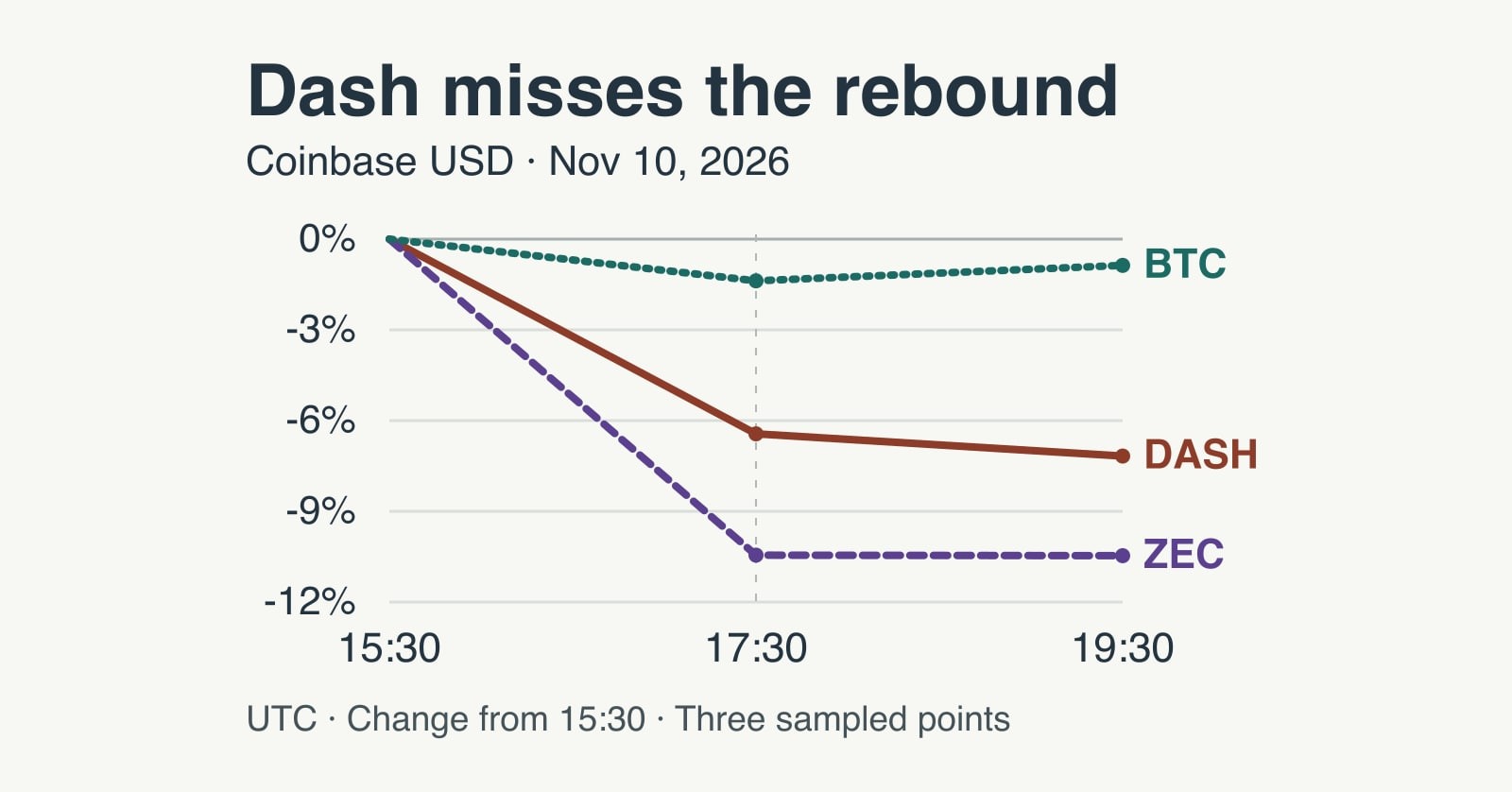
Dash fell 8.09% in the 24 hours to 19:30 UTC on November 10, from $46.74 to $42.96 in Coinbase’s DASH/USD history. The loss was smaller than Zcash’s 11.77% decline but more than five times Bitcoin’s 1.53% drop. In the last two hours of that window, Dash slipped another 0.79% as Bitcoin rose 0.52%.
The difference shows up when the three assets are measured on the same clock. From 15:30 to 17:30 UTC, all three fell. From 17:30 to 19:30 UTC, they went in different directions: Dash lost ground, Zcash was nearly unchanged and Bitcoin regained part of its earlier decline. A separate check of Binance spot markets showed the same split, even though those pairs trade against USDT rather than dollars.
Dash ended the four-hour window at its weakest comparison point
At 15:30 UTC, the five-minute Dash series showed $46.28. Two hours later it showed $43.30, a loss of $2.98 per coin, or 6.44%. By 19:30, another $0.34 had come off that 17:30 mark. The final $42.96 was the lowest of the three comparison points. Other five-minute Dash observations fell both above and below some of those checkpoints, so that sequence should not be read as a continuous fall or as the day’s low.
Zcash’s five-minute series fell from $1,148.635 to $1,028.60 in the first two hours, down 10.45%. Over the next two hours it edged down to $1,028.395, a change of 0.02%. That is effectively flat for this comparison. The small difference does not establish a persistent edge in either direction and is within the sort of variation a different venue or snapshot could show.
Bitcoin’s five-minute series went from $73,983.35 to $72,962.545, down 1.38%, before rising to $73,340.685. The $378.14 bounce recovered about 37% of Bitcoin’s first two-hour dollar loss. Bitcoin still ended below its 15:30 mark. Here, “rebound” refers to the recovery of part of the earlier decline over the specified interval.
The first half-hour helps explain why the two-hour totals differ. From 15:30 to 16:00, Bitcoin fell 1.16%, compared with 2.48% for Dash and 4.98% for Zcash. At 16:00, Bitcoin had already lost about 84% of the dollar amount it would be down at 17:30. Dash had lost about 39% of its own first two-hour dollar decline by then. The two assets both went lower over those two hours, but the balance of the loss arrived at different times. The shares compare net changes between checkpoints; they do not measure how much traded during those intervals.
The bigger daily loser was more stable in the final two hours
The 24-hour ranking puts Zcash last of the three. Its weekly USD history shows $1,165.555 at 19:30 UTC on November 9 and $1,028.395 at the same time on November 10. Dash’s 8.09% decline sat between that 11.77% drop and the 1.53% decline in Bitcoin’s weekly USD history.
The two-hour ranking tells a different story. Dash’s return from 17:30 to 19:30 lagged Bitcoin’s by 1.30 percentage points, based on the unrounded returns. It also lagged Zcash, even though Zcash had fallen much more in both the preceding two hours and the full day. Put another way, the asset with the biggest 24-hour loss was not the asset that lost the most ground after 17:30.
That reversal is useful when a market page shows a single rolling change. The 24-hour number is a comparison with a previous day’s price. It cannot tell a reader whether the recent part of the session looked like stabilization or continued weakness. In this case, comparing the same snapshots for all three assets makes the difference visible without comparing changes captured at different times.
How sensitive is the result to the ending time?
Moving both ends of the daily window back 30 minutes, to 19:00 UTC, puts Dash’s 24-hour loss at 7.80%, Zcash’s at 11.35% and Bitcoin’s at 1.60%. All three are still negative, and the ranking is unchanged. In that earlier window, Dash went from $47.175 to $43.495, compared with $46.74 to $42.96 in the later window. The 8.09% figure should be read with its timestamp, rather than as a closing print for the calendar day.
The short-window result depends more on the choice of endpoint. Dash was at $43.495 at 19:00, slightly above its 17:30 mark, before falling to $42.96 by 19:30. It would therefore be inaccurate to say that Dash never bounced after 17:30. Its bounce had faded by the final checkpoint, when Bitcoin was still above its own 17:30 mark. At 19:00, all three were above their 17:30 marks: Dash by 0.45%, Zcash by 0.79% and Bitcoin by 0.60%. A comparison taken there would have shown three partial recoveries. The extra half-hour left only Bitcoin meaningfully above its 17:30 level. The last checkpoint matters more here than the mere presence of an intraperiod bounce. Observations after the cutoff can change the comparison again.
What the second market confirmed
CoinAbout checked completed five-minute Binance spot bars at the equivalent UTC boundaries. From 17:30 to 19:30, the DASH/USDT close fell and the BTC/USDT close rose. ZEC/USDT was close to flat, though its change was slightly positive rather than slightly negative. This check supports the relative ranking and the distinction between Dash weakness and Bitcoin’s partial recovery. It does not support assigning meaning to Zcash’s tiny change in either series.
The Binance closes and Coinbase observations were calculated separately. USDT and dollars are different quote currencies, and an exchange’s last trade before a five-minute boundary is a different measure from an indicative historical observation. No Binance price was substituted for a missing Coinbase value. Agreement across the two series is useful for direction and relative timing; it does not make either series a record of every trade or show what a large order could have executed at.
What the data can and cannot show
For the Coinbase comparison, each percentage change is the later price minus the earlier price, divided by the earlier price. The daily returns use matched weekly-series observations exactly 24 hours apart. The afternoon comparisons use the five-minute series, with the key 15:30, 17:30 and 19:30 UTC observations checked against the weekly series. The plotted lines connect those three observations only. Each asset starts at zero on the chart because its 15:30 price is the denominator for the plotted returns. This keeps Bitcoin’s much higher dollar price from overwhelming the scale. The 17:30-to-19:30 returns in the text are calculated separately, using the 17:30 price as the denominator. The chart makes the turn visible; the interval calculation measures the size of that turn from where each asset actually stood at 17:30.
Some shared times outside those checkpoints differed between the day and week responses. For example, Dash’s 17:00 reading was $43.04 in the five-minute history and $42.40 in the weekly response. Neither reading enters the quoted returns or the chart. This is also why the result is framed around selected timestamps and makes no claim about the exact low, the order in which every trade occurred, or how much liquidity was available at an individual print.
Dash and Zcash are two examples. They do not constitute a price index. The comparison cannot establish whether other assets with similar uses moved the same way. It also cannot show what caused the selloff or whether the late divergence will persist. A longer period of synchronized observations across more markets, with separate transaction and depth data, would help answer those questions. The finding here is narrower: over the same final two hours, Bitcoin took back some of its earlier loss, Zcash was nearly steady, and Dash finished below where it started.
Send a correction or source question about this article.
Related Posts
Ether falls 5.8% in 24 hours and comes within $4 of $2,000
Ether fell 5.77% in a matched 24-hour Coinbase dollar window. A five-minute comparison shows how its drop and partial rebound differed from Bitcoin and Solana.
Arbitrum falls 7.2% while Ondo rises 6.1% in the same 24 hours
Arbitrum fell 7.23% and Ondo rose 6.13% in the same Coinbase dollar window. A five-minute timeline shows how the 13.36-point gap opened.
Zcash falls 5.3% in 24 hours, with most of the drop in two hours
Coinbase dollar observations put ZEC at $1,153.87 after a 5.32% decline. Two hours explain most of the loss, while Bitcoin edged higher on the same clock.